
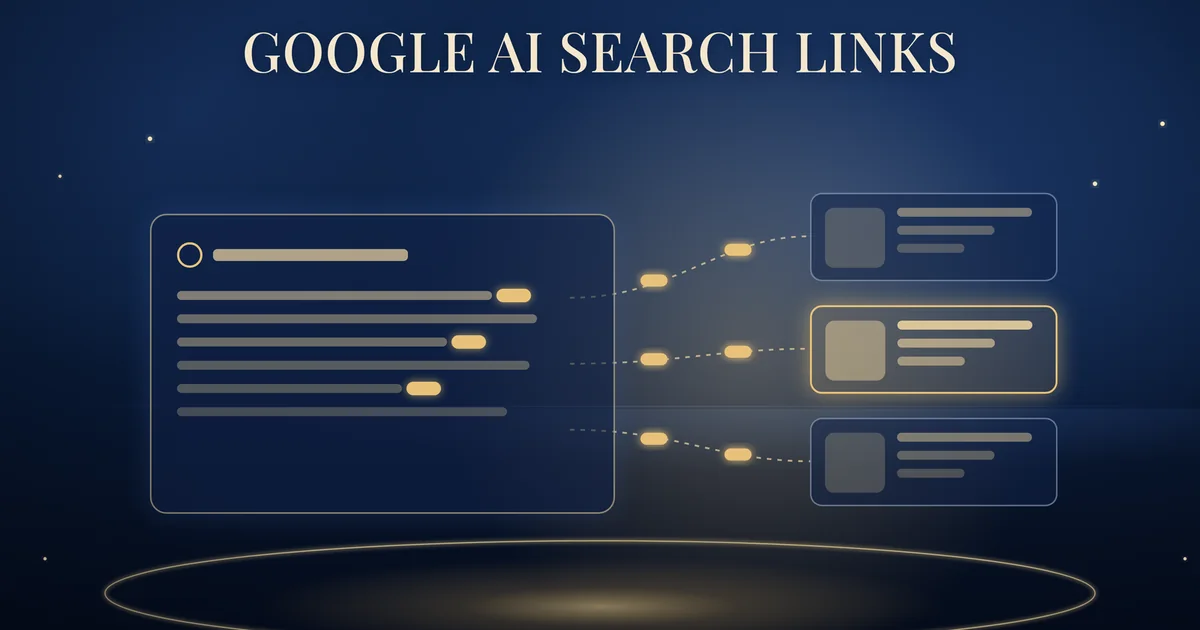
Google’s AI answers are starting to point people outwards more often. In its Search blog post More ways to connect with the web from Search, dated 15 October 2026 (US time; 16 October in Singapore), Google set out five changes to how AI Mode and AI Overviews show and link to web sources.
For Singapore consumer brands, the question shifts. Being mentioned in an AI answer is one thing. Being the page that answer links to is another. This guide covers each change, Preferred Sources and a monthly link check. If you want the wider picture of measuring how AI tools describe your brand, our AI visibility guide for Singapore brands covers that, so we will not repeat it here.
What Google changed on 15 October
Google described five updates. Two of them are tests, and the post says so.
- More inline links, higher up. Google wrote: “We’re also launching updates to show inline links higher up in responses more frequently, helping to ensure key sources are easily clickable right when you need them.”
- An official pages section (test). Google noted: “Sometimes, there are only one or two official places on the web to complete a specific task or get the exact info you need.” It added: “We’ll be testing a new display in Search AI experiences to prominently surface these links in a dedicated section at the top of a response, with context about why each link is useful.”
- Timely article carousels. Google said: “We’re starting to roll out the prominent carousels you see for timely articles in AI Search features to additional locations and languages globally. These carousels also highlight your Preferred Sources”
- Richer related links. Google wrote that “we’re making the links that we show at the end of some AI responses more engaging and prominent, with image thumbnails and a more clickable design.”
- Clickable creator names (test). Google said: “This week, we started testing clickable creator and publisher names on video results that link directly to their Search profiles in AI Mode.”
Google names no Singapore dates. The official pages section and creator names are tests, so prepare for them rather than count on them.
Inline links: be the page worth linking
Inline links sit inside the answer itself, next to the point they support. Google decides which source to link, and no brand can guarantee a place there. What you can control is whether your page is a clear, specific match for the question.
Our recommendation: look at the questions shoppers actually ask about your category and make sure one page on your site answers each one directly. Put the answer near the top of the section, use plain headings that mirror the question, and include the specific facts a person needs, such as sizes, materials, care steps or opening hours. Our guide to SEO vs AEO vs GEO explains why answer-first pages help across search and AI tools.
Official pages: make the task page obvious
The official pages test is the change most relevant to consumer brands. Many brand questions are tasks with one right destination: finding an outlet, checking opening hours, returning an item, claiming a warranty, booking an appointment, checking delivery areas or reading product care instructions.
Our recommendation is to plan one clear page per task. Give each page a descriptive title and a simple URL, keep the facts identical everywhere they appear, and make sure your Google Business Profile matches your website on names, addresses and hours.
This is planning, not a guarantee. Google is only testing the display, and it has not said when or where it will appear.
Hypothetical illustration, not a client example: a Singapore bubble tea chain searches its own returns and outlet hours questions in AI Mode and finds the answers link to a third-party listing. It creates one clear outlets page and one refunds page, aligns its Google Business Profile hours with the outlets page, and checks again the next month.
Preferred Sources: for brands that publish
Preferred Sources lets people choose sites they want to see more often in Google. The choice belongs to the user. A brand can invite readers to pick it, but it cannot add itself.
According to Google’s Search Central guide Help your readers find your site through preferred sources, last updated 18 September 2026: “In AI Mode and AI Overviews, your content can be highlighted with a “preferred” badge for users who have selected your site as a preferred source.” The same guide says: “Preferred sources can also appear in AI Mode and AI Overviews in all languages and locales where those features are available.”
There are eligibility rules to check:
- “Only domain-level and subdomain-level sites are eligible to appear in the source preferences tool.”
- “you must make sure your site is included in Search generative AI features in Search Console”
The guide also describes a button, a custom button and a deeplink you can use to invite readers, for example in a newsletter or a social post. On these, Google says: “It’s not required to do them in order to appear as a preferred source.”
Be realistic about fit. Preferred Sources matters most if you publish useful content regularly. Google’s Search Help page on Preferred Sources (undated, read on 30 October 2026) notes: “Sources that aren’t updated regularly may not be available.”
Carousels and related links
Timely article carousels are expanding to more locations and languages, and Google has not said which. Related links at the end of some answers now show image thumbnails. Both reward content pages with a clear, descriptive title and a strong, relevant lead image. Our Google Lens image SEO guide covers image basics such as file names, alt text and quality.
Search profiles for brands with video
Google’s test of clickable creator and publisher names leads to Search profiles. Google introduced these profiles in a 4 June 2026 Search blog post, describing room for an “avatar, bio, website, social media and video platforms”.
If your brand publishes video or creator content, our recommendation is to check whether a Search profile is available to you and keep your channel names consistent. Google has not stated Singapore availability on the pages we read. Our short-form video SEO guide covers titles and descriptions for video.
Paid links are separate
These organic links cannot be bought. Ads in AI Mode are a separate, labelled placement, which we covered in our post on Google AI Mode ads in Singapore.
A monthly link check for Singapore brands
Our recommendation is a short routine, run once a month:
- Search your key task questions and category questions in AI Mode.
- Note whether your own page is linked inline, near the top or in the related links, and which other sites appear instead.
- Fix the task page for any question where a third party is linked in your place.
- Confirm the Search Console setting that keeps your site included in Search generative AI features.
- For the full measurement routine across AI tools, follow the steps in our AI visibility guide linked above.
Growth System 90 is our planning approach for folding a check like this into a quarter’s content and search work. Set a performance target for which task pages should be the linked source, and review it each month.
For more on the site foundations that AI tools read, our SEO service page covers technical and content work.
What we don’t know yet
- Singapore timing. The official pages section and clickable creator names are tests, with no Singapore date.
- Clicks. Google has not published click data for these placements. Our AI visibility guide explains what the current reports can and cannot show.
- Search profiles. Eligibility outside the US is not stated on the pages we read.
- Carousels. Google says “additional locations and languages globally” without naming them.
FAQs
What did Google change about links in AI Mode and AI Overviews?
Google is showing more inline links higher up in responses, expanding timely article carousels to more locations and languages and making related links more prominent with thumbnails. A section for official pages and clickable creator names are tests.
Can my brand pay to be the linked source in an AI answer?
No. Organic links are separate from ads.
What are Preferred Sources in AI Mode?
They are sites a user chooses to see more often. Google says this content “can be highlighted with a “preferred” badge” in AI Mode and AI Overviews.
Is my brand website eligible to be a preferred source?
Only domain-level and subdomain-level sites are eligible, and your site must be included in Search generative AI features in Search Console. Google’s Search Help also notes: “Sources that aren’t updated regularly may not be available.”
How do I make my store or returns page the official link Google shows?
You cannot choose it. Google is only testing this display. Our recommendation is one clear page per task with consistent facts across your site and Google Business Profile.
How is this different from measuring AI visibility?
This post covers being linked in Google’s AI answers. Measuring how ChatGPT, Perplexity and other tools describe your brand is covered in our AI visibility guide.