
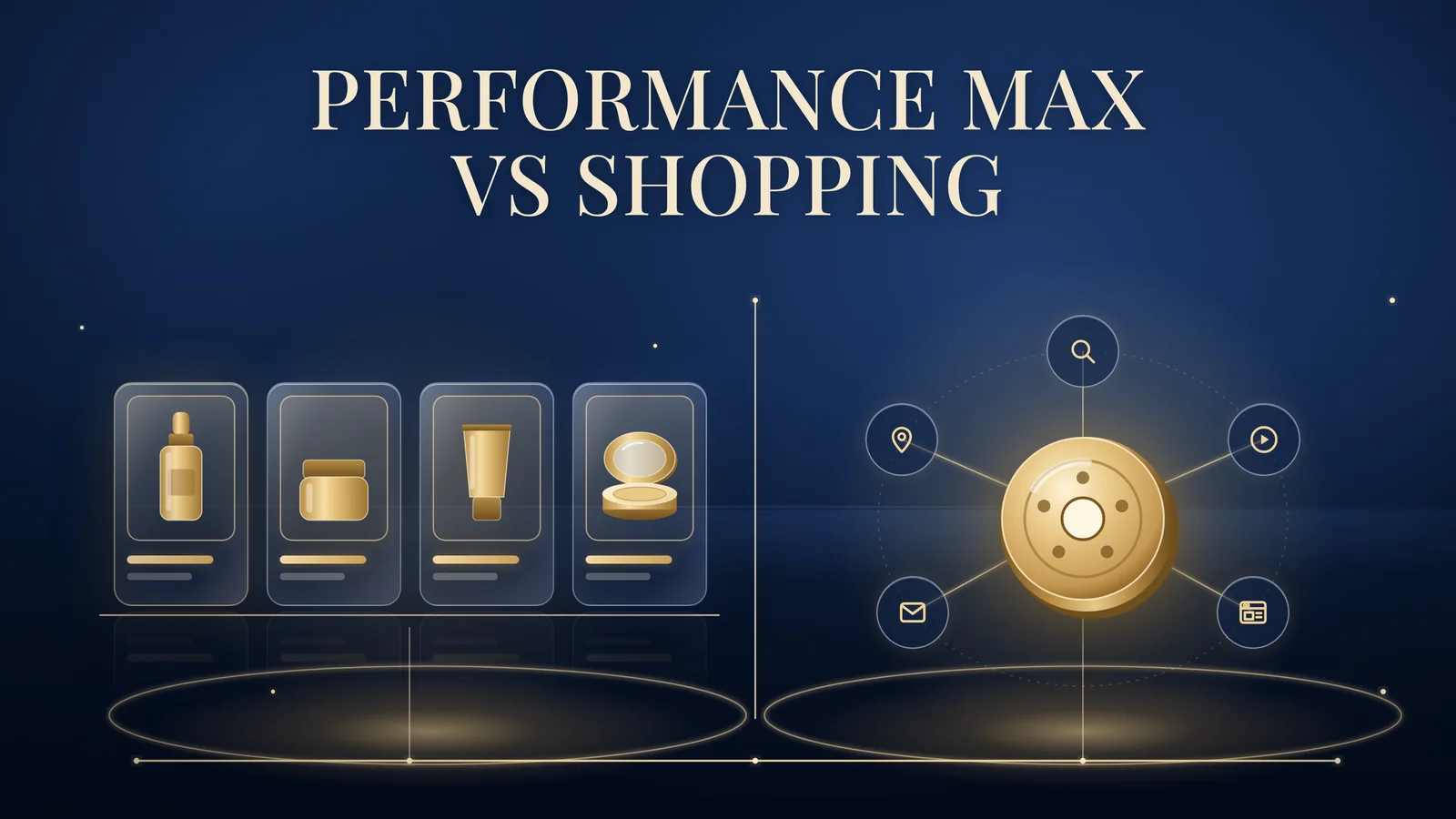
Performance Max and Standard Shopping both show your products from a Merchant Center feed. Standard Shopping gives more manual control over Shopping placements; Performance Max uses Google AI across Search, Shopping, YouTube, Display and more from one campaign. Brands Win, a Singapore-based performance marketing agency, helps consumer brands decide which to run, or test both.
Checked against Google Ads Help and Google Merchant Center Help, October 2026.
The short answer: a decision table
Neither campaign type is better for every store. The choice depends on how much control you need, how reliable your tracking is and what creative you have.
This table is our practitioner guidance, not a Google rule:
| Your situation | Standard Shopping | Performance Max | Run both |
|---|---|---|---|
| You need tight control over products and bids | Strong fit | Less control | Keep key products in Shopping |
| Conversion tracking is patchy | Can run on Manual CPC while you fix it | Weak fit: it bids towards conversions or conversion value | Fix tracking first |
| Video and image assets | Not needed | Uses text, images and video | Add PMax once assets exist |
| Catalogue | A few hero products | A wider range | Split by product group |
| Comfort with automation | Low | High | Test with an experiment |
How Standard Shopping works
Standard Shopping turns your product feed into ads on Google’s Shopping surfaces, and you control bids by product group.
Google’s About Shopping ads page (2026) says Shopping ads use “your existing Merchant Center product data (not keywords)” to decide how and where to show. Shopping campaigns reach the Shopping tab, Google Search next to results, Google Images and, if you opt in, Search Partner sites. You pay per click.
Bidding options listed on that page are Target ROAS, Maximize Clicks, Maximize Conversion Value and Manual CPC. By default, ads are built from your feed; Google says additional creative assets “are not available yet” for Shopping campaigns.
Google also offers AI Max for Shopping, a one-click beta upgrade for Shopping campaigns announced on 30 April 2026. Its help page (2026) says “text customization” can rewrite product titles to match searches (English feeds only), and Final URL expansion, which needs Target ROAS, can add text ads and other landing pages. Google says you keep product targeting controls and bidding flexibility. Check rewritten titles for beauty claims.
If the same product sits in several Shopping campaigns, Google’s campaign priority article (2026) explains the rule. You set each campaign to Low, Medium or High. The highest-priority campaign bids, and if it runs out of budget, the next one bids. Use it to ring-fence a sale or a hero product.
How Performance Max works for retailers
Performance Max is one goal-based campaign that can serve across all of Google’s inventory.
Google’s About Performance Max campaigns page (2026) describes “a goal-based campaign type that allows you to access all Google Ads inventory, including YouTube, Display, Search, Discover, Gmail, and Maps, from a single campaign.”
You supply the inputs: conversion goals and values, text, images and video grouped into asset groups, audience signals and your feed. Controls include brand exclusions, negative keywords, search themes and Final URL expansion. Bidding is Maximize Conversions or Maximize Conversion Value, with an optional target.
Google can also generate text and video assets; beauty brands should check them for unsubstantiated claims.
Where YouTube and Display fit
Because Performance Max can show video and display ads, weak creative shows up in more places, so supply your own video.
When you want a deliberate YouTube or Display campaign with its own budget and reporting, run it separately as YouTube ads or display and remarketing campaigns. Google’s Demand Gen page (2026) says Demand Gen gives “more control over creative testing, audience targeting, and specific placements on YouTube and Discover”. The same page says Google Display Ads campaigns are moving to Demand Gen: from June 2026, eligible advertisers can move existing campaigns voluntarily with a migration tool, and Google says new campaigns will later only be created in Demand Gen.
Running both: how Google decides which campaign serves
You can run both for the same products, and Google will choose by Ad Rank.
Google’s article on how Performance Max interacts with other campaigns (2026) says that where several campaigns could serve for the same impression, “Google Ads prioritizes the campaign with the highest Ad Rank.” The stated exception is Search: a Search campaign with a keyword that exactly matches, or is spell-corrected to, the query is preferred over Performance Max.
The article sets out no separate rule for Standard Shopping, so keep overlap deliberate: decide which products live where.
How to test one against the other
Google offers a built-in Standard Shopping vs Performance Max experiment (2026). You pick an existing Standard Shopping campaign, split traffic and compare it with a new or existing Performance Max campaign. Google recommends setting the same target ROAS in both.
Your feed matters more than the campaign type
Both campaign types depend on the same Merchant Center feed, so fix the feed first.
Google’s Product data specification (2026) warns that “incorrect, inaccurate, or missing product information can cause disapprovals, limited eligibility, incorrect displays for your products”. Common problems it names include wrong GTIN values, missing variant attributes such as colour or size, low-quality images and conflicting data between your feed and website.
For a Singapore store, that means:
- Titles that name the brand, product, size and shade.
- Prices in SGD that match the product page, including sale prices.
- Availability that updates when stock runs out.
- Shade names and sizes written exactly as on the pack and the site.
As a labelled hypothetical: a small Singapore skincare brand might keep its three best-selling serums in Standard Shopping at High priority and test Performance Max on the rest of the range.
Our Google Ads management starts with a feed and tracking check.
Measuring results for a Singapore online store
Judge Google’s numbers against your store’s orders before moving budget.
- Track purchases with values, and check that your store and Google record the same orders.
- Compare Google’s reported sales with Shopify, WooCommerce or your order system each week.
- Watch brand searches. Performance Max can serve on Search, including searches for your brand name; Google lists brand exclusions among its controls if you want to measure new demand separately.
Our guide on why platform figures and store orders differ covers this in more depth. Whoever runs the campaigns, keep the accounts in your name: at Brands Win, clients own their Google Ads and Merchant Center accounts and pay Google directly.
A 90-day way to decide
A 90-day window gives you time to audit, launch, test and review.
Our Growth System 90 programme follows that rhythm: Discover (feed and tracking audit), Launch (campaign set-up or an experiment), Optimise, then Review against one performance target. It runs Google alongside Meta and TikTok ads, marketplace channels such as Shopee and TikTok Shop, influencer marketing and content strategy over 90 days, with one team responsible for the result. See our paid media services across Google, Meta and TikTok or all our services.
FAQs about Performance Max vs Shopping
What is the difference between Performance Max and Google Shopping ads?
Standard Shopping shows feed-based ads on the Shopping tab, Search results, Google Images and optional Search Partners, with manual or automated bidding. Performance Max uses your feed and assets across all Google Ads inventory, including YouTube, Display, Gmail and Maps, with automated bidding only, according to Google Ads Help.
Is Standard Shopping still worth running in 2026?
Yes, for brands that want control over which products get budget and how much they bid, or that are still building conversion data. Google still supports and documents Standard Shopping, including campaign priority settings and a built-in experiment for testing it against Performance Max, so it remains a sound starting point.
Can I run Performance Max and Standard Shopping for the same products?
Yes. Google says that where campaigns could serve for the same impression, it prioritises the one with the highest Ad Rank, with an exception for exact-match Search keywords. Keep product overlap deliberate so you know which campaign is doing the work.
Do I need videos for Performance Max?
Not strictly. Google accepts text, images and video in Performance Max asset groups and can generate assets for you. Supplying your own video gives you more control over how your brand appears on YouTube, and lets you check every claim first. See our YouTube ads and video and image assets for ads.
How do I test Performance Max against Shopping?
Use Google’s Standard Shopping vs Performance Max experiment in the Experiments section of Google Ads. Pick one existing Shopping campaign, split traffic, set the same target ROAS in both and leave it running long enough to gather sales. Avoid changing budgets or the feed mid-test. No test guarantees an uplift.
Who owns the Google Ads and Merchant Center accounts if an agency runs them?
At Brands Win, you do. Clients own their Google Ads and Merchant Center accounts and pay Google directly, and we work inside them with the access you grant. If you change agencies, your campaigns, conversion data and product feed stay in your accounts, so nothing has to be rebuilt from scratch.